






























No part of this publication may be reproduced, or transmitted, or stored, in any form or
by any means, electronic, mechanical, photocopying, recording, or otherwise, without
the prior written permission of SheetMetalWorkBook.com
Sixth Edition Reformatted for Internet
©2012 SheetMetalWorkBook.com





90 Degree Bends
When developing flat length for 90 degree bends always make sure the dimensions are outside
to outside. Using the example to the right let us
say the material thickness is .050 and the bend
radius is .032. Our bend allowance would be:
(.0078 x .050 + .01743 x .032) x 90 = .085
Now we can calculate the bend deduction:
2 x (.050 + .032) = .164
.164 - .085 = .079 B.D.
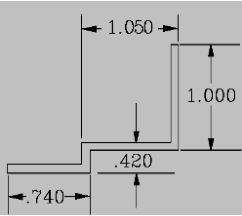
Look at the two pictures closely and notice
the different way each is dimensioned. They are
both identical parts. The first picture is shown
dimensioned like a typical blueprint. The second
is the dimensions we need for our flat pattern
development. We got the bottom dimensions from
the information on the first drawing.
Note that the .370 dimension is located from
outside of a bend to the inside of a bend. We
will have to add a material thickness to the .370
dim. making it .420. The 1.050 dim. on the bottom
picture came from subtracting .740 from 1.740
which would give us a distance of 1.000 from
outside to inside. Now we have to add a material
thickness to the 1.000 dim. making it 1.050 which
now gives us all of our outside dimensions. We
can do our development next.
Below is an easy way of keeping track of our
bends and bend deductions. You can count the
B.D.'s and see that we are figuring for 3 bends.
.740
-.079 B.D.
.661
+.420
1.081
-.079 B.D.
1.002
+1.050
2.052
-.079 B.D.
1.973
+1.000
2.973 = Flat stretch out
bends always make sure the dimensions are outside
to outside. Using the example to the right let us
say the material thickness is .050 and the bend
radius is .032. Our bend allowance would be:
(.0078 x .050 + .01743 x .032) x 90 = .085
Now we can calculate the bend deduction:
2 x (.050 + .032) = .164
.164 - .085 = .079 B.D.
Look at the two pictures closely and notice
the different way each is dimensioned. They are
both identical parts. The first picture is shown
dimensioned like a typical blueprint. The second
is the dimensions we need for our flat pattern
development. We got the bottom dimensions from
the information on the first drawing.
Note that the .370 dimension is located from
outside of a bend to the inside of a bend. We
will have to add a material thickness to the .370
dim. making it .420. The 1.050 dim. on the bottom
picture came from subtracting .740 from 1.740
which would give us a distance of 1.000 from
outside to inside. Now we have to add a material
thickness to the 1.000 dim. making it 1.050 which
now gives us all of our outside dimensions. We
can do our development next.
Below is an easy way of keeping track of our
bends and bend deductions. You can count the
B.D.'s and see that we are figuring for 3 bends.
.740
-.079 B.D.
.661
+.420
1.081
-.079 B.D.
1.002
+1.050
2.052
-.079 B.D.
1.973
+1.000
2.973 = Flat stretch out
bends always make sure the dimensions are outside
to outside. Using the example to the right let us
say the material thickness is .050 and the bend
radius is .032. Our bend allowance would be:
(.0078 x .050 + .01743 x .032) x 90 = .085
Now we can calculate the bend deduction:
2 x (.050 + .032) = .164
.164 - .085 = .079 B.D.
Look at the two pictures closely and notice
the different way each is dimensioned. They are
both identical parts. The first picture is shown
dimensioned like a typical blueprint. The second
is the dimensions we need for our flat pattern
development. We got the bottom dimensions from
the information on the first drawing.
Note that the .370 dimension is located from
outside of a bend to the inside of a bend. We
will have to add a material thickness to the .370
dim. making it .420. The 1.050 dim. on the bottom
picture came from subtracting .740 from 1.740
which would give us a distance of 1.000 from
outside to inside. Now we have to add a material
thickness to the 1.000 dim. making it 1.050 which
now gives us all of our outside dimensions. We
can do our development next.
Below is an easy way of keeping track of our
bends and bend deductions. You can count the
B.D.'s and see that we are figuring for 3 bends.
.740
-.079 B.D.
.661
+.420
1.081
-.079 B.D.
1.002
+1.050
2.052
-.079 B.D.
1.973
+1.000
2.973 = Flat stretch out