
1. If * = 30 degrees What is #:
2. What is ?:
3. What is $:
4. If # = 95 degrees What is *:
5. What is $:
6. What is ?:
7. If * = 43 degrees What is #:
8. What is ?:

































INTERSECTING LINES AND
ANGLE RELATIONS



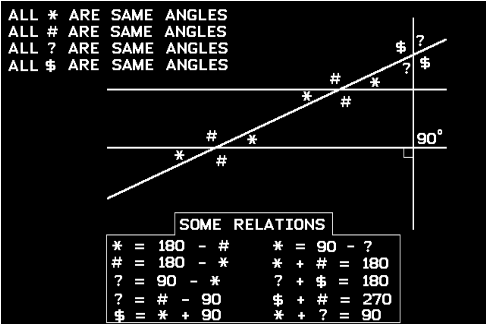
The two horizontal line segments are parallel
to each other and perpendicular to the vertical
line segment. For this illustration the # angle
should not be less than 90 degrees and the *
angle should not be greater than 90 degrees
although most of the relations will still be
true even if they are. For example * + # is
still equal to 180 degrees no matter if * is
greater or lesser than 90. Same for ? + $.
Pay real close attention to this lesson.
These angles are very important because the
angle you may need is not the angle that the
engineer may have given you on the blueprint.

No part of this publication may be reproduced, or transmitted, or stored, in any form or
by any means, electronic, mechanical, photocopying, recording, or otherwise, without
the prior written permission of SheetMetalWorkBook.com
Sixth Edition Reformatted for Internet
©2012 SheetMetalWorkBook.com