






























No part of this publication may be reproduced, or transmitted, or stored, in any form or
by any means, electronic, mechanical, photocopying, recording, or otherwise, without
the prior written permission of SheetMetalWorkBook.com
Sixth Edition Reformatted for Internet
©2012 SheetMetalWorkBook.com





Dimensioning Internal Features
Dimensioning internal features is done the same way as figuring developed lengths or widths. Bend deduction or bend allowance
compensation has to be used when calculating the placement of
internal fea-tures. Holes and cutouts can be dimensioned on
blueprints many different ways. Some of these can be: from outside
apex of material of a bend, inside apex of material of a bend, or
from an outside edge of the part.
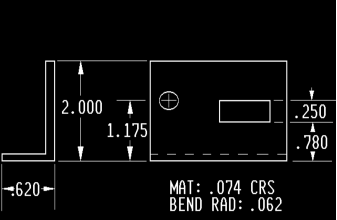
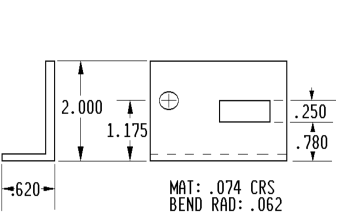
In the illustrations below the top picture is a representation
of a formed angle as it would possibly appear on a blueprint. The
hole and cutout is located from the outside apex of the material.
Since this is a ninety degree bend it is also tangent to the bend.
to calculate the placement of the hole from the bottom of the
blank you would take .620 minus the bend deduction of .123 and
then add 1.175 giving you 1.672.
developed lengths or widths. Bend deduction or bend allowance
compensation has to be used when calculating the placement of
internal fea-tures. Holes and cutouts can be dimensioned on
blueprints many different ways. Some of these can be: from outside
apex of material of a bend, inside apex of material of a bend, or
from an outside edge of the part.
In the illustrations below the top picture is a representation
of a formed angle as it would possibly appear on a blueprint. The
hole and cutout is located from the outside apex of the material.
Since this is a ninety degree bend it is also tangent to the bend.
to calculate the placement of the hole from the bottom of the
blank you would take .620 minus the bend deduction of .123 and
then add 1.175 giving you 1.672.
developed lengths or widths. Bend deduction or bend allowance
compensation has to be used when calculating the placement of
internal fea-tures. Holes and cutouts can be dimensioned on
blueprints many different ways. Some of these can be: from outside
apex of material of a bend, inside apex of material of a bend, or
from an outside edge of the part.
In the illustrations below the top picture is a representation
of a formed angle as it would possibly appear on a blueprint. The
hole and cutout is located from the outside apex of the material.
Since this is a ninety degree bend it is also tangent to the bend.
to calculate the placement of the hole from the bottom of the
blank you would take .620 minus the bend deduction of .123 and
then add 1.175 giving you 1.672.
When you get to the acute and
obtuse bend sections remember that
internal features are calculated
the same ways that are used for
developing overall lengths and
widths. Just imagine that the
dimensions used from the bends to
the outside edges are going to
internal features instead.
obtuse bend sections remember that
internal features are calculated
the same ways that are used for
developing overall lengths and
widths. Just imagine that the
dimensions used from the bends to
the outside edges are going to
internal features instead.
Use .123 Bend Deduction
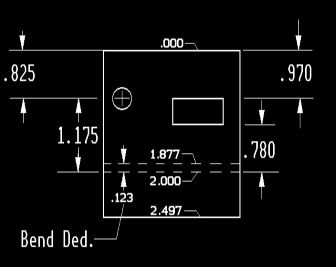
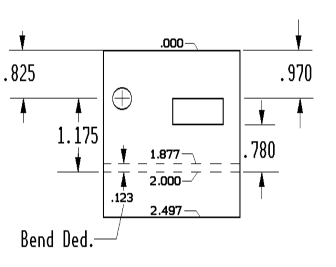
FLAT PATTERN SAMPLE 2
Dimensions placed from
top of flat part
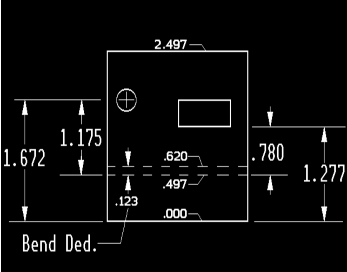
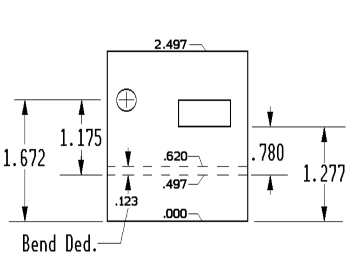
FLAT PATTERN SAMPLE 1
Dimensions placed from
bottom of flat part