

































Facts:
1. Has 3 angles and 3 sides.
2. Sum of all angles = 180 degrees
3. Isosceles triangle has two sides that are equal
4. Equilateral triangle has three equal sides
And three equal angles, which are always
60 degrees each, (180 3) remember rule 2!
5. An acute angles is less than 90 degrees.
6. An obtuse angle is greater than 90 degrees.
THE RIGHT ANGLE TRIANGLE IS A VERY USEFUL TOOL!
Look around and see how many things can be divided into
right angles. One of the keys to developing complex sheet
metal parts is by breaking them down into simple right
angles. They aren't usually drawn on the blueprint for you.
You will have to look for them and imagine where they go. (At
the bottom of page:14 there is an example of a commonly used
right angle in Precision sheet metal development.)
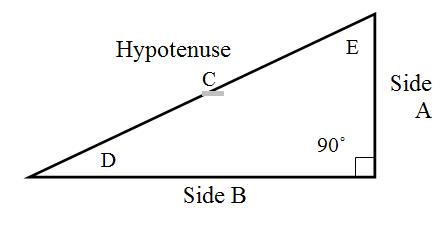
1. One angle must = 90 degrees
2. The sum of the other two angles
must = 90 degrees
3. The right angle sides are called the legs.
4. The side opposite the right angle is
called the hypotenuse.
Using the
5. If B = A then both D and E = 45 degrees.
figure below:
6. If B > A then E > 45 degrees
7. D + E = 90 degrees
8. B
2
+ A
2
= C
2
Pythagorean theorem
http://www.dvcplanners.com

TRIANGLES



No part of this publication may be reproduced, or transmitted, or stored, in any form or
by any means, electronic, mechanical, photocopying, recording, or otherwise, without
the prior written permission of SheetMetalWorkBook.com
Sixth Edition Reformatted for Internet
©2012 SheetMetalWorkBook.com